What is hail and how does it form?
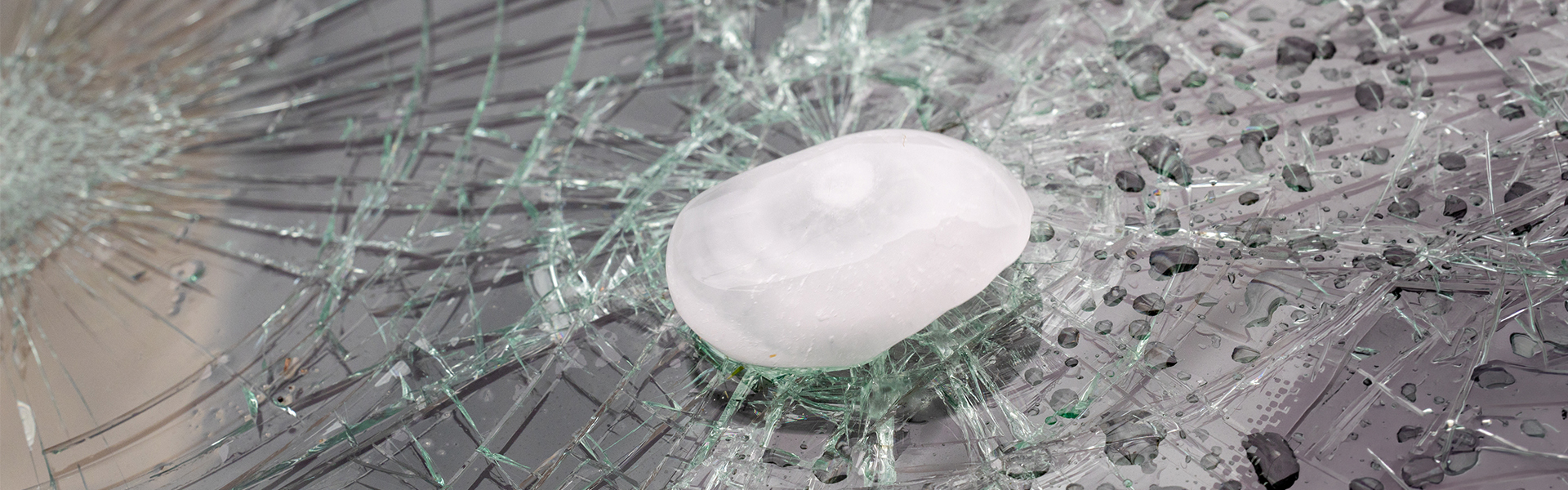
The German Weather Service (DWD) defines hail as precipitation in the form of ice balls or ice lumps. These usually have a diameter of 5 to 50 mm; in extreme incidents even over 100 mm.
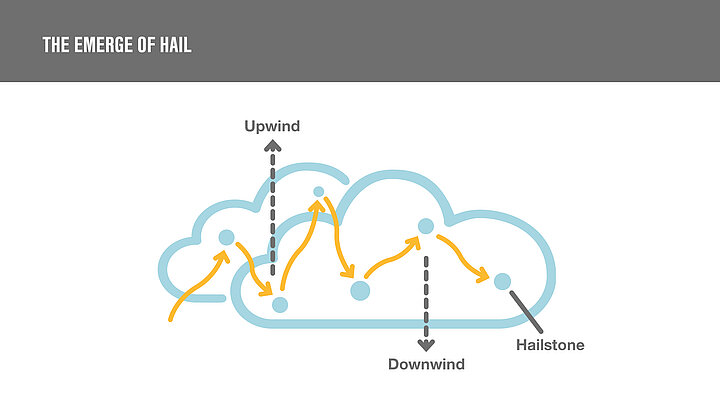
Hailstones form in thunderclouds and occur when prevailing ice crystals and supercooled water combine through a collision. The whirled-up ice crystals are shot up by strong winds and freeze into small hailstones. From altitudes of around 12,000 metres, however, the intensity of the wind decreases and the ice drops move downwards again. On the way down, the ice drops combine with other raindrops and their size increases. The resulting hailstones grow by moving up and down in the cloud several times.
If the hailstones are then too large and heavy, they fall from the cloud to the earth. The force with which they arrive at the earth depends on the size and mass of the hailstones. Consequently, the damage they can cause is smaller or greater.
According to the Hagelregister, the risk of hail is most likely with high humidity. Hail formation is also favoured when the air near the ground heats up very quickly.
Hazards due to hail
Particularly hard-hit regions
Some areas are particularly affected due to their geographical location. Hail is particularly common in Switzerland and Austria. In Germany, too, hail is causing more and more damage.
In 2019, it hailed around Whitsun, first in Munich, then in the Harz mountains and later in the Erzgebirge mountains for three days. Thousands of cars were damaged during this storm. Buildings and window panes were broken by the hailstones, some of which were up to six and a half centimetres in size. In the south and east of Germany, property damage amounted to approximately 260 million euros – making this storm one of the ten strongest hailstorms since 1997. The worst case of hail occurred in 2013. In Germany, a hailstone measuring 14.1 centimetres was found in the Swabian Alps at the time. The total insured property damage from this storm amounts to more than 3 billion euros.
According to the Natural Hazards Report 2020, the state of Bavaria is particularly affected by hail. Here, hail damage amounting to 675 million euros was recorded in 2019 alone. Measured by the frequency of damage, however, Saarland is in the lead, followed by Saxony and Rhineland-Palatinate.
The hail resistance classes
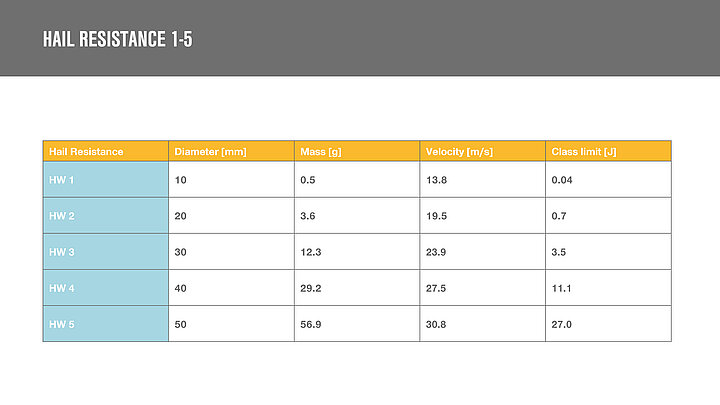
Due to the increasing incidence of severe weather, building materials are classified in terms of their resistance to hail.
Five hail resistance classes (HW 1 - 5) are defined. If a component is classified in the first hail resistance class, it has only very weak hail resistance. Whereas the highest HW has very strong hail resistance. The classification is made after calculating the mass, speed and diameter of the hailstones that the building materials can withstand. In addition to these factors, the resistance classes are also calculated on the basis of the kinetic energy with which the hailstone of a certain size hits the building envelope. In other words, for the lowest HW 1, this means that components remain damage-free when hit by a hailstone with a diameter of 10 mm, but can be battered by larger hailstones. Components in the highest hail resistance class can even withstand hailstones up to 50 mm in diameter and remain undamaged.
Damage definition
In the case of hail damage to a car, it cannot be said in blanket terms that it will always cost €1000. Similar to the damage to the building, the damage to building components cannot be defined in a general way, as it has to be determined individually for each building component based on the circumstances. In addition, components usually have more than one function, which can be affected differently by hail, for example. Let's take skylights as an example: These must be waterproof, because one of their jobs is to prevent water from penetrating into the interior of the building. In addition, the light that enters the interior of the building through a skylight should be maximised as much as possible. The heat radiation, on the other hand, should be minimised. These three functions can be impeded by damage caused by hail.
Another function of the component is usually the mechanics. In the case of a skylight such as a rooflight dome or a flat roof window, for example, this can be the mechanical opening in the event of a fire. Such a mechanism can therefore also be damaged by hail. Last but not least, the appearance is of course also affected by hail damage, as the ugly dents in the profiles of flat roof windows and the like can be visually disturbing, especially on roofs with a top view.
A damage definition must therefore be made individually and after assessing the damage to the affected component.